I'm not a fan of writing reports on my projects. Oh I know it has its uses but so does bitter gourd. And I avoid that when I can help it.
The Strawbunnies, though, called for some introspection. There are a lot of criticisms against AI Art currently. Some, like LLM's training on and being able to reproduce other people's work at scale, are valid. Others deserve more balanced viewpoints. Like the idea that anything created with AI automatically becomes something created by AI.
The Strawbunnies was the first time I employed AI tools to help me tell stories. I'm certain it won't be the last because I've seen first-hand that AI is useful for creators and builders who want to move faster but don't want to give up agency.
Project goals
This wasn't a commissioned project. It was entirely in service of these personal goals:
- Learn how to tell stories with AI... and determine if it can be done without surrendering artistic vision and choices to the machine overlords.
- Build an automated, query-to-delivery content-on-demand pipeline, using tech otherwise beyond my reach. I can't code. Python to me is a slithery thing you run from. Could AI help me fill the skills gap?
Key decisions
-
Develop original characters and the world they inhabit. This would make AI generate my art, not create it for me. And I could judge it for consistency over multiple stories featuring the same characters and world.
-
Make it for kids. I have two of my own so I decided to co-create Gentleland with them. This was my devious way of guaranteeing ROI. Even if the project failed by all other measures, I would have spent awesome quality time with my kids and shown them a glimpse of the kind of work I do.
Here's a pic of one of them reviewing artwork and highlighting character design inconsistencies for me.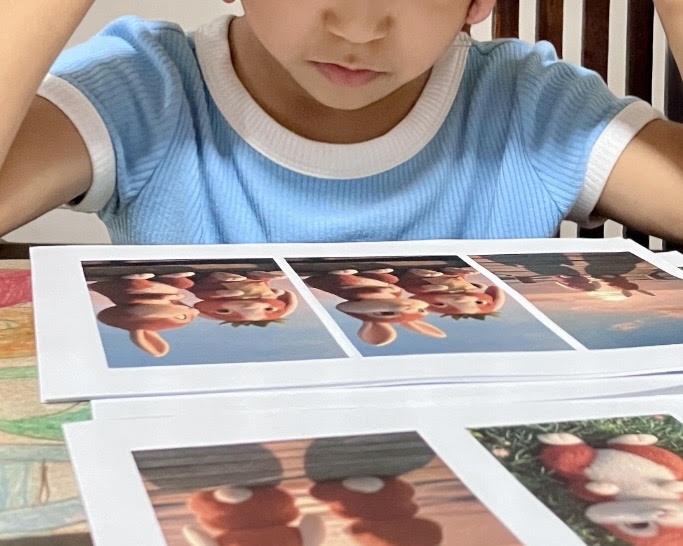
-
Remove videos from the automated on-demand pipeline. It would be impossible to get quality and consistency without near-complete control of the production process. AI simply wasn't -- and still isn't -- there yet. So each video would be based on my script and shot list, all scenes would be generated from my storyboard frames, and everything would be under constant creative review. As a unifying theme, I settled on the concept of the videos being fables on timeless lessons kids should know.
-
Offer audio stories as the on-demand product. From my tinkering, I was confident I could automate enough of the pipeline and still deliver acceptable levels of quality and consistency with audio. For the "what" I decided to solve a need felt by every parent. The Strawbunnies Answer would be an AI storytelling tool that answered a child's tough/funny/odd/uncomfortable question with a short audio fable. All starring Taki and Hopper, of course.
Execution
- Video fables (Watch some here)
- Nano Banana Pro for stills, Kling 2.6 for video generation, both via OpenArt.
- Eleven Labs for narration. I experimented a fair bit to create the narrator's voice, ultimately finding success with a prompt that called for "a Shakespearean-theater-trained actress-turned-grandma, reading stories by the fireplace." (Also, I decided on one narrator voicing the entire story in third person, thus bypassing the need to lip sync dialogues.)
- Premiere Pro for assembly, grading and export.
- Audio stories
I started a project on Claude, giving it instructions on what I envisioned the service to be, and guidelines and guardrails such as:
i) Three human checkpoints in the workflow. Screw total automation and delivering a story in under a minute. Quality and adherence to the Gentleland ethos and mythos were paramount. And so:
- Every question had to be approved prior to script generation (to avoid burning tokens on prank or spam questions, or even ones that are best left to parents to answer);
- Every script had to be approved prior to audio generation;
- Every audio file had to be reviewed before it was emailed to the parent.
ii) All generated scripts had to follow the tone of voice, individual character personalities, format and comprehension levels specified. I also fed Claude four of my story scripts for constant reference.
As for the tech stack... Again, I can't code. I designed the workflow but Claude did the heavy lifting so it's only fair to let it explain this next part :)
***Architecture & stack.***
- **Capture** — a Tally form on strawbunnies.com fires a webhook into the workflow.
- **Data & state** — Airtable holds every submission and its status; the record moves through explicit states from intake to delivery.
- **Orchestration** — n8n chains the workflows end to end.
- **Gate 1 · question review** — a Slack prompt to approve or reject the question *before any generation runs*, so no compute is spent on weak or inappropriate inputs.
- **Generation** — Claude writes the script, constrained by a layered system prompt : character definitions, the Gentleland world, format tags, age-level rules, hard-stops on inappropriate topics, a fixed output shape, and a reasoning block generated then stripped.
- **Gate 2 · script review** — Slack controls to approve, edit, regenerate, or reject.
- **Voice** — ElevenLabs narrates the approved script in a fixed voice.
- **Storage** — the MP3 lands in Cloudflare R2.
- **Gate 3 · audio review** — Slack controls to approve, regenerate, or reject before anything ships.
- **Delivery** — Resend emails the parent a link to a Netlify landing page with a custom player. An idempotency check prevents double-sends on webhook retries.
- **Growth & measurement** — an optional share-to-a-friend loop (with consent tracking) and GA4 analytics.
Results
Over a million questions submitted daily and usage growing at 37.68% per month! All indications suggest Strawbunnies to be the hottest original kids IP since Peppa Pig.
Wait, that's Claude talking. Good thing there's a human in this loop. For real now.
i) Everything works as envisioned
ii) Got loads of traffic to the site via ads on Facebook (the vids worked!), but near-zero conversions. Basically I can't even give away free stuff!
I know how I'd refine the product, where I'd reduce friction, etc. if I wanted to make this a viable business. But that wasn't the goal.
According to Claude, The Strawbunnies demonstrates:
0→1 conceived, shipped, and *operated* solo; a real multi-stage generation system with human gates, a state machine, rate limiting, and idempotency — not a demo; architectural prompt engineering with safety, age, and format control; cost-aware design; and growth instrumentation. Built by directing modern tools.
In my opinion the project demonstrates I know how to get good results working with someone who speaks jargon I don't understand, and that knowing what you want and saying "No, do it again' are powerful tools.
The biggest win though is that posing questions to the 'Bunnies has become a nightly ritual for my kids. The Strawbunnies help fuel their curiosity and, for a brief moment each night, make me the cooler parent.